Swimming in the Danube in the past and the future – Public art installation and programme series in the framework of Flaszter I. Budapest Biennale of Contemporary Public Art.
In the autumn of 2023, we participated in Flaszter I. Budapest Biennale of Contemporary Public Art. with our project “River Baths in Budapest”, where we placed our peep-boxes, so-called SKUBIs, on the Buda and Pest quays, marking the sites of former river baths, and built an installation next to the Vigadó on the Jane Haining quay, recalling the mechanicsm of the river baths.
Our public space objects and the related programmes not only evoked the history of the river baths, but also made us think about how to reintroduce urban bathing into the public consciousness, how to see the Danube as a (liquid) public space, and what contemporary examples of urban bathing exist in other Western European cities.
But why a river bath?
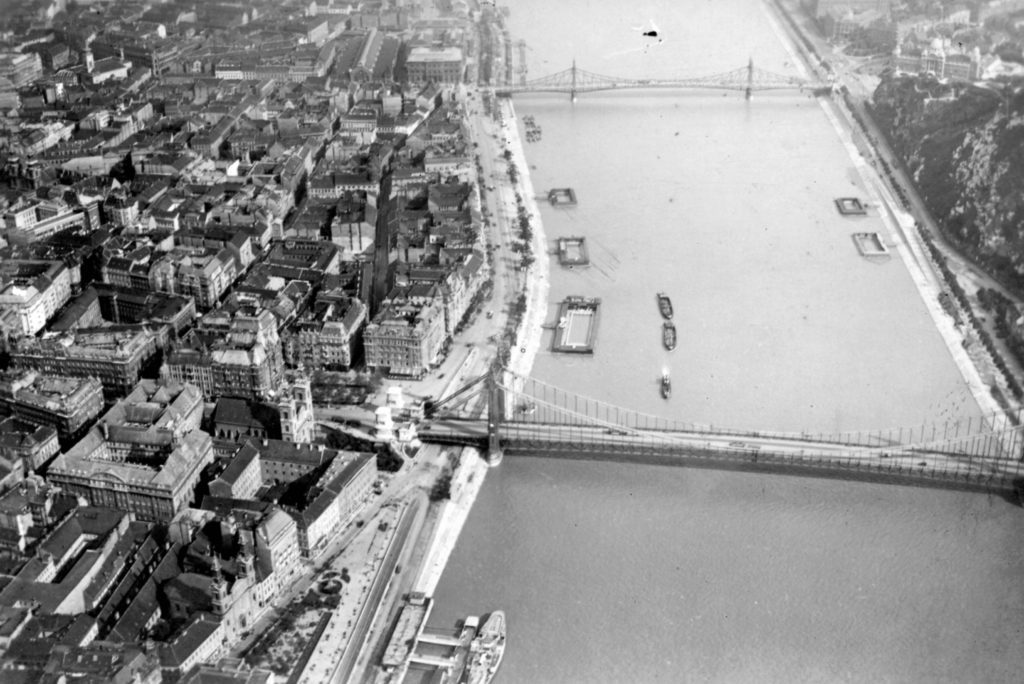
Bathing in the Danube in the capital has always raised some important city-use issues. The first so-called river-baths in the 1810s-20s enclosed small areas of the Danube and made open water bathing safe and accessible to all until the Second World War, but later, due to a lack of funds and pollution, it was banned by regulation. The 2010s brought a breakthrough for bathing in Budapest: thanks to improved water quality, a free beach at the Roman coast opened for one day in 2019 and 2020, and for a month in 2021, and as the only designated Danube beach in the city, it has been open every summer since then.
With the River Baths in Budapest project, we aim to show that swimming in the Danube has a past, a present and a future: in 2024, we would like to see the construction of the first Budapest river bathing complex of the 21st century and to include Budapest in the list of “swimmable” cities.
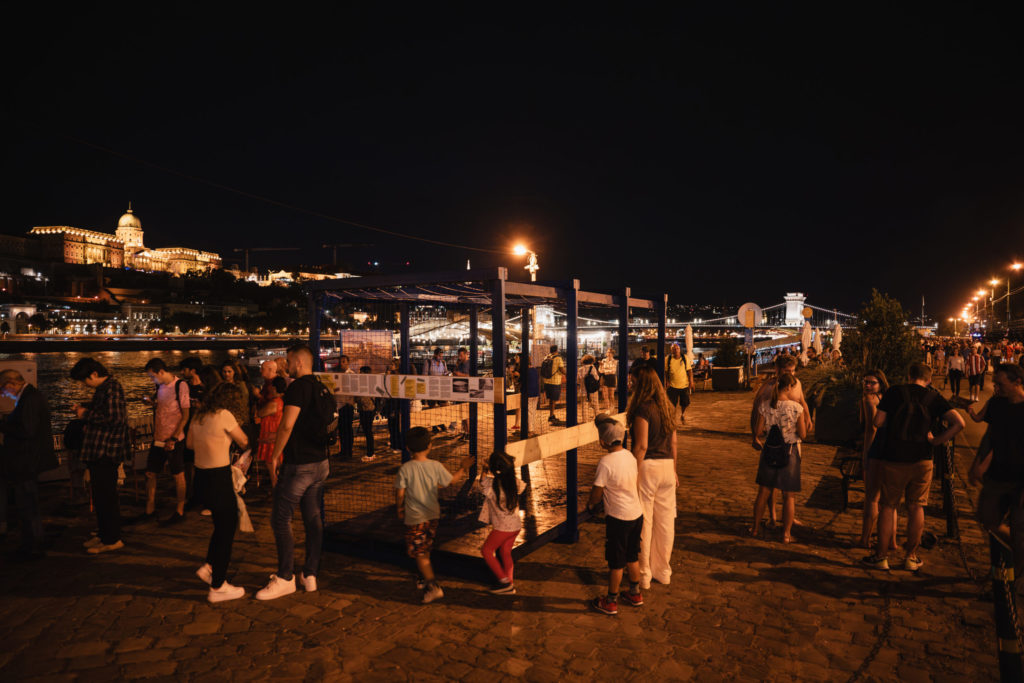
River bath installation at Jane Haining Quay
An upside-down river-bath installation near the Vigadó Square boat station demonstrated the principle of the Danube baths: a wooden structure and a net that prevents the water from washing you away. In the flipped-over pool, the water was above us, the sun’s rays shining through the ripples of the water gave the impression of being in an old wooden river bath, and in the evenings it evoked the experience of a night swim.
On the day of the opening, we launched Hibrid Dessous’ exclusive Budapest swimwear collection with a group swim and photo session, and inagurated the installation to those who wish to swim in the future with a dry-land swimming performance.
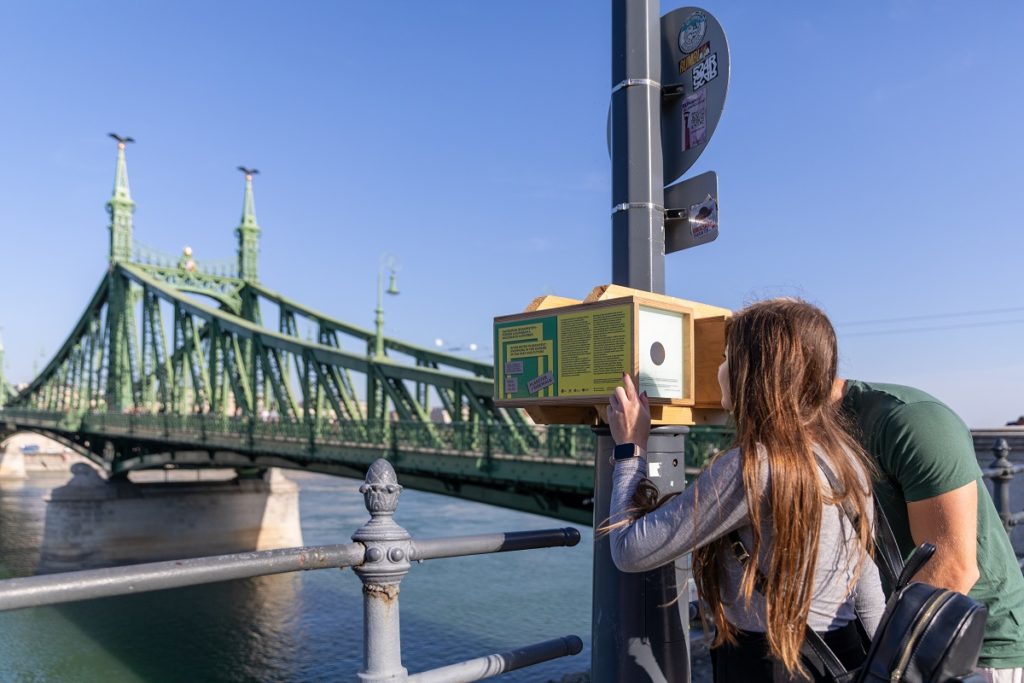
SKUBI’s on the sites of former river baths
The SKUBI boxes at nine locations near the locations of the former baths along the Danube River, presented the river baths of Budapest and Europe in the past and present to the visitors through pictures. In connection with the SKUBIs, bike tours were organised where participants explored the sites of the old baths and experienced the idea of a tangible Danube and of liquid public space.
The project was realized in the framework of the Flaszter – I. Budapest Biennale of Contemporary Public Art., as part of the Budapest 150 program series, with the support of the Municipality of Budapest, and in the organization of the BTM Budapest Gallery.