In December 2024, the Budapest City Council voted to commission a feasibility study on the creation of a Danube Bath (open-air swimming pool) in Budapest. We played a significant role in this—and it is a great pleasure for us.
At the request of Budapest Spas and Thermal Waters Llc. (Budapest Gyógyfürdői és Hévizei Zrt. / BGYH), we also participated in writing the Danube Bath Feasibility Study:
– we explored the history of bathing in the Danube,
– we analyzed successful international examples and solutions,
– we examined 49 potential locations in Budapest, which we categorized by size and feasibility.
The section of the study written by us can be viewed here.
Through the preparation of this study, we have been working operationally with BGYH since 2025 to create new Danube bathing sites. The first result of this is the Árasztó-part public beach, which opened in August 2025.
History of Baths
Bathing in the Danube on the Pest and Buda sides began as early as the early 19th century—and it was much more than just a summer pastime.
The first Danube baths were built in the 1810s and 1820s. These seasonal facilities, typically equipped with rows of cabins, pools, and bathing baskets, operated during the season from May to September. Afterward, they were towed to another location or dismantled, and were rebuilt in the spring. The first public bath opened in 1836.
In 1836, the same year the first public bath in the capital opened, the first large-scale open-water swimming competition was held, stretching from this bath to the Royal Salt House. These short-distance swims starting from the Danube Baths were called “swim-outs.” This event soon evolved into a swim stretching from Margaret Island all the way to Csepel Island, crossing the entire city, and its tradition—the so-called swimming excursion—survived until the 1860s.
Subsequently, swimming became institutionalized, and by the early 20th century, at least nine river baths were operating on the Danube in Budapest. At the same time, open-water swimming gradually faded into the background.
During World War II, the Danube Baths were severely damaged. Although the city council had plans to rebuild them, a shortage of timber, followed by deteriorating water quality caused by industrial pollution, ultimately sealed their fate. In 1973, swimming in the Danube was completely banned, and the riverbanks were gradually taken over by cars.
In 2023, at the first Budapest Public Space Contemporary Art Biennial, the peep boxes developed by Valyo—known as SKUBIs—were installed at the sites of Budapest’s former Danube baths: by looking into the boxes, we not only evoked the swimming pools of that era, but also highlighted the possibilities of the future through contemporary Western European examples.
Swimming Map of Budapest
In this study, we examined 49 locations within the city limits where new bathing areas could be developed in the near future. For each type of bathing area, we identified example sites that clearly illustrate the advantages and challenges of that particular design.

Bathing areas can truly become an integral part of city dwellers’ daily lives only if they are located near popular recreational venues and can be used in conjunction with them—for example, in the vicinity of parks and promenades.
Connecting to existing green spaces and recreational infrastructure not only enhances usability but also strengthens integration into community life.
Types of Shores
There are more suitable locations along the Danube in Budapest for establishing Danube baths or public beaches than one might think. This is primarily determined by the type and height of the riverbank, as these factors influence access to the water.
– Along the built up riverbanks in the city center, floating structures, traditional river swimming pools, and Danube baths need to be built.
– In suburban areas/sections, on paved or grassy sloping banks, access to the water can be provided via stairs, ramps, or piers.
– Natural sandy beaches are suitable for creating public beaches: here, swimmers can walk right into the water.
There are numerous other factors to consider when designating a specific location:
Characteristics of the Danube branch
We have divided the branches of the Danube in Budapest into four groups. These differ in terms of the speed of the flow and the volume of boat traffic—and thus offer different options for swimming.
Surrounding public spaces
While busy main roads pose the primary obstacle along the Danube riverbanks in the city center, in the suburbs, accessibility is often limited by the lack of sidewalks or unpaved routes that are difficult to walk along.
Environmental and Safety Requirements
This includes the proximity of wastewater treatment plants and the level of environmental protection—factors that fundamentally influence the usability, sustainability, and development potential of a bathing site.
Urban Structure
The site’s role in the urban fabric and the size of the immediately accessible population are important factors in establishing a bathing area.
The 2011 Development Study Plan for Budapest’s Danube-front Areas served as a starting point; based on urban structure and land-use analyses, it divided the city’s riverside areas into eight zones. Existing infrastructure, as well as implementation and operational conditions, also play a decisive role.
Furthermore, regulatory, ownership, and usage conditions also have a fundamental influence.
Based on these factors, we established a set of criteria and sought to identify as many areas as possible where the establishment of a new bathing site is feasible.
Types of Bathing Areas
Public beach on the main branch
The public beaches established along the main branch of the Danube are suitable not only for cooling off but also for swimming. In the case of these sandy, open-water areas streching as long of the shore as possible, it is advisable to preserve the natural shoreline and the shade provided by the floodplain trees as much as possible, and to install only the infrastructure that is absolutely necessary.
Of the areas examined in the Danube Bathing Area Feasibility Study, the establishment of a main branch open-air beach was proposed at 13 locations—and in addition to the existing Római-part beach, we recommended Árasztó-part as a priority location.

Bay Beach
At the public beaches located in the bay, even less confident swimmers and children can bathe and swim safely, as they can cool off in water that is almost completely still.
Opening hours should be adjusted to fit the work schedules of city residents; in the summer, the beaches should remain open until 9 p.m., or until dark. In addition to the Flava Beach already operating in Kopaszi Bay, we have proposed such a beach in the bay of Palotai Island in Újpest. By connecting to the existing infrastructure of local restaurants, the city could be enriched with a public beach offering shallow-water swimming.

Public beach on the Ráckeve-Soroksár branch of the Danube
The Ráckeve-Soroksár branch of the Danube (RSD) is a regulated waterway enclosed by sluice gates—essentially a body of standing water—along whose banks and islands vacation homes, boathouses, and fishing huts were first built, followed later by family homes.
We examined five potential sites for establishing a public beach; more specifically, we looked at the area connected to the Pesterzsébet Iodine-Salt Spa and Beach, where such a beach had previously operated.

Central Danube Bath
In the downtown section of Budapest, the main branch of the Danube has a strong current, and the banks consist of stone-paved slopes or high, vertical stone walls—here, one can trace the historical tradition of river baths.
The first Danube baths were built in the 1810s and 1820s. These seasonally operated facilities, typically featuring rows of cabins, pools, and bathing baskets, were open from May through September.
In the Feasibility Study, the establishment of a central Danube Bath facility was proposed for 15 of the sites we examined—based on the points given, the top-ranked site was the Jane Haining Embankment, near Vigadó.

Local Danube Baths
A small, wooden-framed pier with an opening in the center that allows people to enter the water and swim. This type of pier is an excellent small-scale structure that enables city dwellers to experience flowing water in safe conditions, even in suburban areas.
Due to its expandable pool size, it can be suitable not only for recreational cooling off but also for swimming: depending on demand—and with a larger budget—baths of the size shown at the central Danube Bath can also be constructed at the locations described as local Danube Baths.
We examined the feasibility at ten locations in the city—with the Athletics Stadium as a priority area.

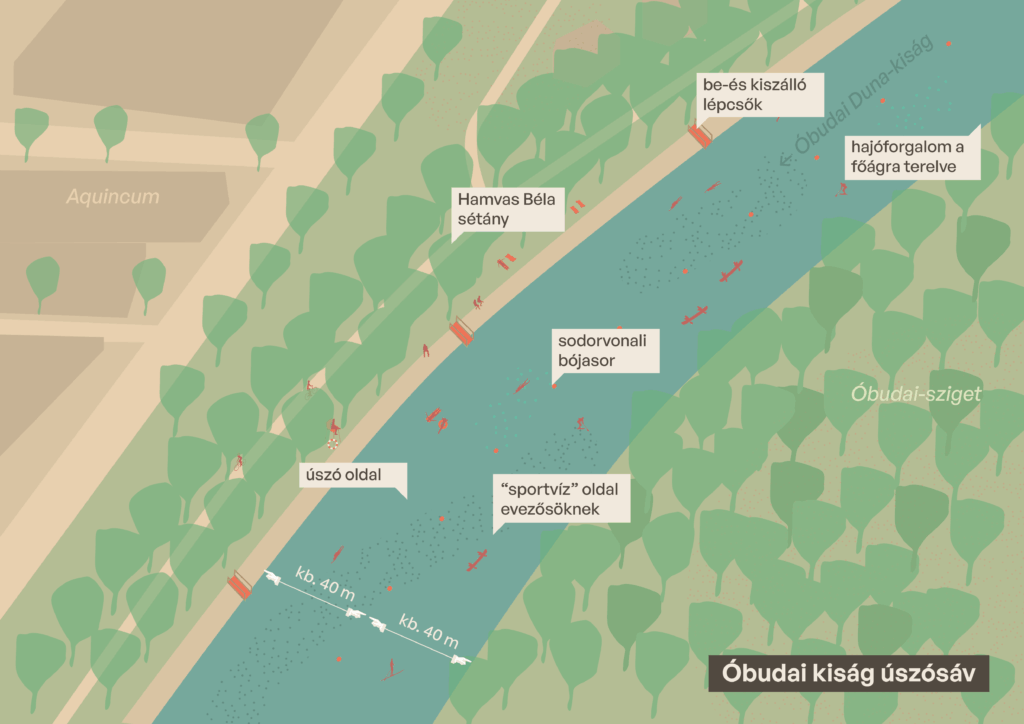
Swimming lane
A swimming lane is a longer section of a river with a stronger current, marked by buoys, featuring safely designed and clearly marked entry and exit points.
In the context of Budapest, this refers to a lane at least several hundred meters long in a branch of the Danube or in the main channel regulated for sports, where swimming is permitted and which cannot be crossed even by small motorboats. We have designated three such lanes: along Óbuda Island, Margaret Island, and Bert Promenade.
Next goals
Following the completion of the study, Valyo’s next goal is to make it possible to swim in the Danube in more and more locations each year, with increasing confidence:
– Keep the Római and Árasztó beaches open—covering an ever-larger area.
– Depending on the weather, make it possible to extend the beaches’ operating hours.
– The planning and preparation of the river swimming pool should continue over the next 2–3 years. We hope that the Margaret Island and downtown Jane Haining sections can also be opened for the Danube Baths.
– Further develop water quality monitoring at potential beach sites, and continuously expand online communication platforms so that anyone can check the Danube’s current water quality at any time.
And in the long term: let Budapest once again become a bathing city where everyone can cool off, whether at a public beach, the Danube Baths, or even designated swimming lanes.